
How is the ASVAB scored? Learn more about how to read ASVAB scores and understand your results.
Odyssey ASVAB Interpretation is on Wednesday, February 11, 2026, at 11:00 am in room D.
The ASVAB is an aptitude test that measures developed abilities to help predict future academic and career success. ASVAB, short for Armed Services Vocational Aptitude Battery, was initially designed as a military test in 1968, but it was soon recognized that its robustness rendered it suitable for civilian jobs as well, thereby establishing it as one of the most widely researched and well-respected aptitude tests available.
The ASVAB’s predictive ability aligns with civilian jobs, those requiring advanced degrees, skilled trade careers, and military jobs. The ASVAB Career Exploration Program (CEP) offers the same aptitude test to students in 10th grade and above to help them learn about themselves and their abilities. ASVAB CEP scores also help participants explore the world of work and create an action plan to realize their career goals.
Understanding how the ASVAB is scored can be tricky. Keep reading to learn everything you need to know about ASVAB scoring.
The ASVAB Score Sheet: Understanding ASVAB Scores
HOW TO READ ASVAB RESULTS
So you’ve taken the test and have your score results. What do all the scores mean?
Your ASVAB Summary Results (ASR) sheet shows three different types of scores:
- Career Exploration Scores
- ASVAB Subtest Scores
- AFQT Score
The tutorial video above will help you understand what all the numbers on your ASVAB Summary Results sheet mean. To further your understanding, a detailed explanation of each score type follows.
CAREER EXPLORATION SCORES
On your ASR, there are three Career Exploration Scores:
- Verbal
- Math
- Science/Technical
Each score highlights your strengths in that area and is based on a combination of the ASVAB subtests. Once you delve into the ASVAB CEP, you will use your Career Exploration Scores to explore the OCCU-Find and discover careers that align with your skills.
ASVAB SUBTESTS
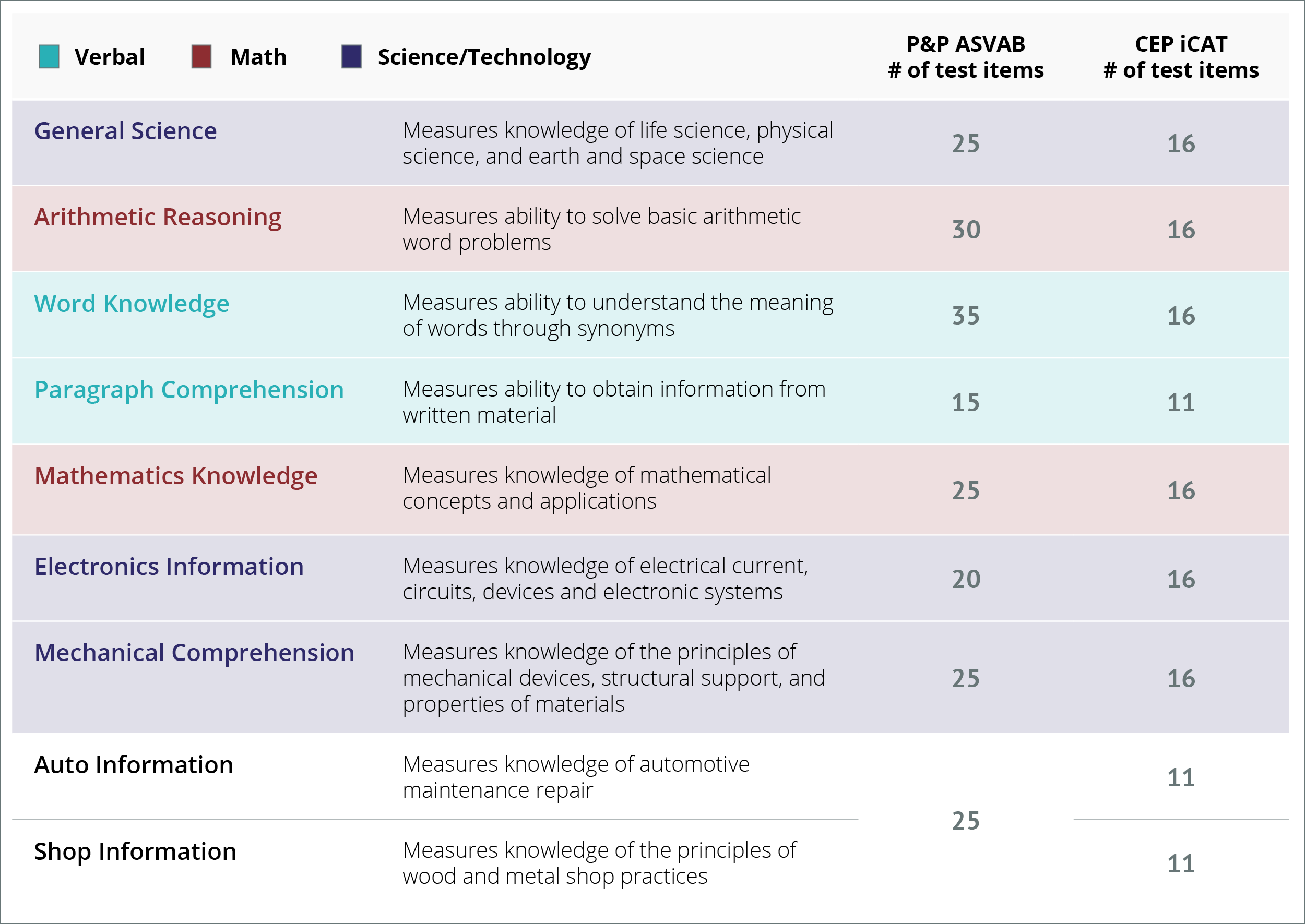
The ASVAB consists of eight subtests. If you take the CEP iCAT computer-based test instead of the paper-and-pencil version, there are nine subtests. You receive a score for each subtest, indicating your specific areas of strength or improvement.
The ASVAB subtests are color-coded to indicate which subtests are used to make up each Career Exploration Score.
The ASVAB subtests can be seen in the chart below:
To find sample questions for each of these subtests, click here.
AFQT SCORE
AFQT stands for Armed Forces Qualification Test. This score is what the military uses to determine your eligibility for enlistment.
The AFQT score is derived from four of the ASVAB subtests, including Arithmetic Reasoning, Mathematics Knowledge, Paragraph Comprehension, and Word Knowledge Subtests. Qualifying AFQT scores can change based on each Service branch’s evolving needs.
Each Service and each military career has different entry requirements. Beyond the AFQT, Service-specific line scores are used to determine eligibility for military jobs. You can log in to see your Military Line Scores here.
For more information on understanding your AFQT score, visit OfficialASVAB.com.
If you are a junior, senior, or post-secondary school student, you can use your ASVAB CEP scores to explore military enlistment up to two years after taking the test.
Discuss your AFQT and military line scores with a recruiter for more information on the military jobs you qualify for.
How to Read Your ASVAB Results
ASVAB SCORE MEANING
The ASVAB is scored differently than other tests that you are familiar with. This test measures knowledge and acquired skills, unlike other tests that measure achievement. The scores you receive do not represent the percentage you got correct. Instead, they are percentile scores, which indicate how well you did compared to others in the same grade and of the same or opposite sex.
Your ASVAB Summary Result sheet and ASVABprogram.com show your ASVAB scores as Percentile Scores, Standard Scores, and Score Bands.
Percentile Scores
Percentile scores indicate how your scores compare to others in the same grade and of the same or opposite sex. They are different from the percent of correct answers. ASVAB percentile scores range from 1 to 99.
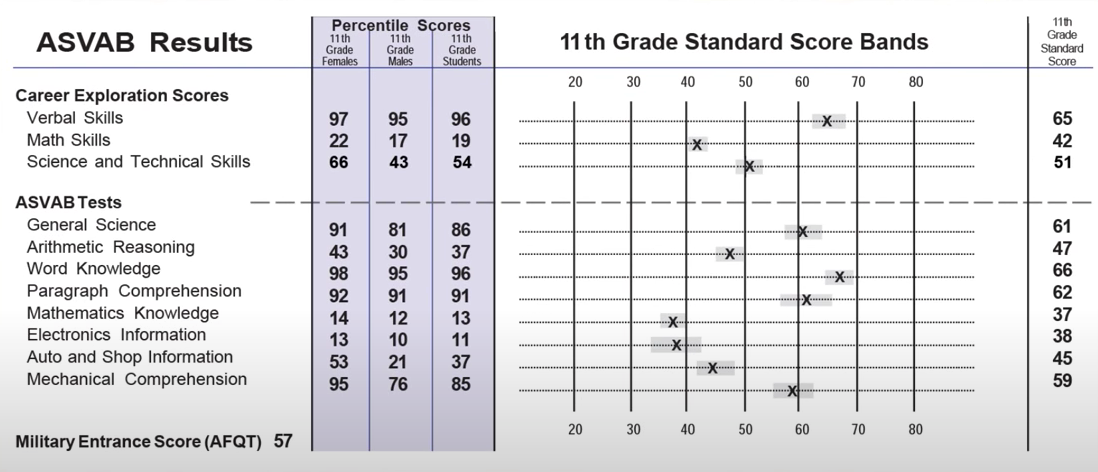
In the ASVAB Summary Results sheet above for Science and Technical Skills: if the student is a female, she scored as well as or better than 66 percent of 11th-grade females; 43 percent as well as or better than 11th-grade males; and 54 percent as well as or better than all 11th-graders.
ASVAB Standard Scores
The Standard Score (in the far right column of the ASR above) is also called the ASVAB Composite Score. These scores are relative to the national average of young adults who took the test in your grade level. With ASVAB Standard scores, most students score between 30 and 70.
This means that a standard score of 50 is an average ASVAB score, and a score of 60 would be an above-average score. According to OfficialASVAB.com, about half of young adults ages 18 to 23 score at or above the standard score of 50, while only 16 percent score at or above 60. There is no minimum ASVAB score.
ASVAB Standard Score Bands
You’ll notice gray shading around each score in the center section. These ASVAB score ranges are called Standard Score Bands. These bands show the score range you’d likely receive if you retake the test without additional preparation.
ASVAB CEP: Career Exploration Using Your ASVAB Scores
The ASVAB Summary Results sheet includes an access code to log into asvabprogram.com. Here, you will find all the career planning features of ASVAB CEP and your ASVAB scores. Students should use the website to get the most out of the many valuable tools for career exploration and post-secondary planning, including:
- The Find Your Interest (FYI) Inventory: A short assessment that helps you understand how your interests relate to occupations.
- The Work Values Activity: A tool to help you identify what you value in the workplace.
- The OCCU-Find: A career catalog that allows you to search for occupations based on your ASVAB results, interests, and more.
- Plan Your Future Dashboard: A unique planning tool that assists you in compiling your achievements and making an action plan for your future goals.
Frequently Asked Questions About ASVAB Scores
WHERE CAN I FIND MY ASVAB SCORE
How to Look Up Your ASVAB Scores
Your ASVAB scores can be found on your ASVAB Summary Results Sheet. You can also request your ASVAB scores online here.
HOW TO CALCULATE ASVAB SCORES
ASVAB scores are calculated differently depending on which version of the ASVAB test you took. There are two versions of the ASVAB: the iCAT (computerized adaptive test) and the P&P (pencil and paper) test.
The iCAT uses a scoring algorithm that measures the difficulty of correctly answered questions and weighs them against the number you answered correctly across all subtests.
P&P ASVAB scores are computed differently. These scores are based only on the number of correctly answered questions across all subtests. For each correct answer, you earn one point. There is no penalty for incorrect answers, so answering every question is beneficial.
WHAT IS A GOOD ASVAB SCORE?
There is no such thing as a good ASVAB score. Compared to other tests you are familiar with, ASVAB CEP participants do not pass or fail the ASVAB because it measures abilities and strengths instead of achievement.
As mentioned above, ASVAB test scores are not reported as percent correct but as percentiles. While a 50 might be a “failing grade” on a typical test, that is not the case with the ASVAB, where a score of 50 is considered average. Students’ scores will differ based on their strengths, proficiency, age, and sex.
AFQT VS ASVAB
Although you can’t pass or fail the ASVAB, it is common for those interested in entering the military to strive for a particular score depending on their desired service branch and job. A military recruiter is the best person to discuss the required AFQT score.
HOW CAN I IMPROVE MY ASVAB SCORE?
To improve a specific score, consider which ASVAB subtests make up that score and focus your studies on those topics.
WHO CAN I TALK TO FOR FURTHER UNDERSTANDING OF MY ASVAB SCORES?
During a post-test interpretation (PTI), an education services specialist (ESS) will offer a comprehensive explanation of your ASVAB scores, detailing their significance and providing guidance on their application. Click here to request your school to schedule a PTI and bring the complete ASVAB Career Exploration Program to your school.
The ASVAB Career Exploration Program (CEP) is a FREE career planning resource available to high schools nationwide. This comprehensive program includes one of the most widely used multiple-aptitude test batteries in the world and an interest inventory complemented by a thorough occupational database all designed to give students an in-depth look at the world of work. To learn more about the program components or how to bring the CEP to your school, click here.